The Second Life of a Sunday Joint: A Monday in The Bull's Kitchen
Monday morning at The Bull has a different sound to Sunday. The river is still doing its slow Wargrave thing outside, but the kitchen is quieter, flatter, more practical. There are no tickets stacked three deep, no one asking whether the cauliflower cheese is coming, no last-minute push on roast potatoes. There is, however, a joint of beef in the fridge with a label on it and a decision to make.
This is the bit most pub menus do not show you. Sunday's roast is not just Sunday's roast. A decent-sized joint is bought for the busiest service of the week, cooked for the busiest service of the week, and then asked to be useful again on Monday. In 2026, with beef where it is and a kitchen team to pay, that second act is not sentimental. It is arithmetic, craft and a small test of whether a pub actually means what it says about wasting less.
Sunday night: the joint comes off the bone
By the time the last plates go out, the joint has already had its moment. It has been seasoned, roasted, rested and carved. Some of it has gone as pink slices with gravy and horseradish. Some has gone as thicker cuts for the people who ask for the end bit. What is left is not a neat rectangle. It is the awkward geography of a roast: a few good slices, some ragged edges, a piece that is a bit too dry, a piece that is a bit too rare for a Monday pie, and a bone that still has plenty to say.
The kitchen does not treat all of it the same. That is the first thing worth understanding. Leftovers are not one substance. The cold beef is looked at, felt, sometimes tasted. The tender middle is kept for the pie. The drier edge pieces are more likely to become a hash, or staff lunch, or something folded through gravy and onions where their slight toughness is not a flaw but a texture. The bone and trim go into a pot for stock if there is room on the stove. The label on the tub has a date on it, because this is a working kitchen, not a fairy tale about thrift.
Monday, 8:40: the sharp knife and the honest bit
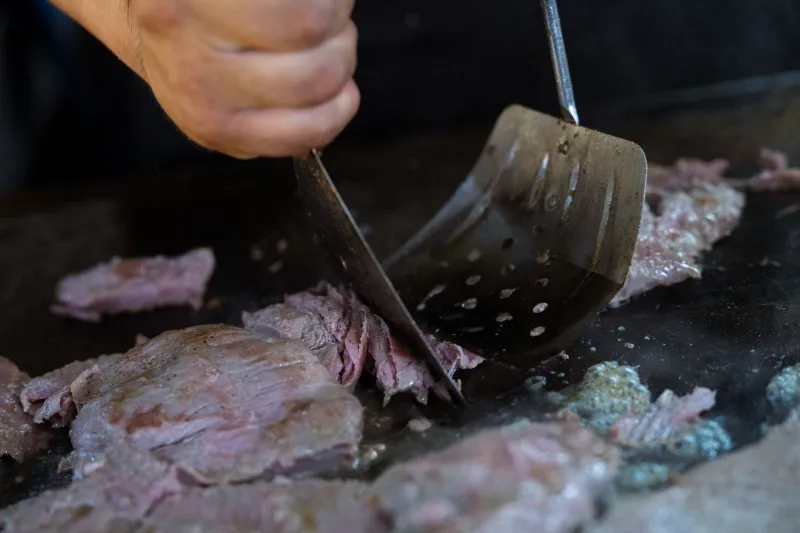
Cold beef is easier to slice than hot beef, but it is also more honest. You can see exactly what you have got. A warm joint can be carved and sent out before anyone notices the dry corner. A cold one sits on the board and asks to be dealt with.
On a Monday, the chef is not trying to recreate Sunday. That would be a losing game. Reheated roast beef sliced thin and slapped next to a new Yorkshire pudding is the kind of pub food that makes people reach for the phone and then not take a photo. The aim is different: make the beef into something that has its own reason for being on the plate.
The pie is the obvious answer, but it is not the lazy answer. Good Monday pie is not a bin with a pastry lid. The beef is cut into pieces that will hold in a sauce. The gravy is built up, maybe with ale, maybe with a little horseradish, maybe with mushrooms if they are in and behaving. The seasoning goes further than it did on Sunday because pastry and potato will dull it. The whole thing is assembled, rested and baked so that the beef has time to soften into the sauce rather than sit in it like a guest who has not been introduced.
The pie that is not on the printed menu
Monday's pie tends not to appear on the website or the printed menu, and that is part of its character. It belongs on the board, next to the soup and whatever fish came in. It is a kitchen saying: this is what we have, this is what we can do with it, and we are not going to pretend it is a brand-new idea.
That is also why it can taste better than the roast. Not always, and not by magic. But a Sunday roast is a performance under pressure. A Monday pie is a slower conversation. The beef has had a night in the fridge, the gravy has had time to think, the pastry gets made without a queue of tickets behind it. The eater is usually less rushed too. A wet Monday in Wargrave does not demand a celebration. It asks for a plate of something hot, a pint if you are that way inclined, and a bit of quiet.
Hash, staff lunch and the bits that do not make the board
Not everything becomes pie. Some beef goes into a hash with potatoes, onions and whatever greens need using. The potatoes dry out a little overnight, which sounds like a problem and is actually the point: they crisp better. The beef catches in the pan, the onions go sweet, and a fried egg on top turns it into a staff lunch that nobody complains about.
Staff lunch is a useful measure of a kitchen. If the team eats well from the same produce that goes to the dining room, the place is probably in decent shape. If the leftovers are only good enough for the bin, the menu was probably too ambitious on Sunday. At The Bull, the Monday staff plate is not a punishment. It is the kitchen closing the loop.
The waste ledger
The cost argument is simple enough. Beef is expensive. Energy is expensive. Labour is expensive. Throwing away a few kilos of cooked meat is not just a moral miss; it is money going out the back door. But the kitchen cannot save its way to a good menu. A Monday pie only works if it is good enough to sell, not merely virtuous enough to justify. There is a difference between using leftovers and serving up a lecture.
The practical rules matter more than the romance. Cool things quickly. Label them. Keep them cold. Do not push a leftover past the point where it is sensible. A pub kitchen has to be disciplined about this, because the alternative is not thrift; it is risk. The Monday pie is a controlled second act, not a free-for-all.
Why the second day can taste better
There is a reason people say stews and pies improve overnight, and it is not just nostalgia for school dinners. Salt and sauce have more time to get into the meat. The beef gives something to the gravy and takes something back. Pastry adds fat and crunch. A sharp pickle or a spoon of mustard cuts through it. The whole plate has more contrast than a plain roast, which is often doing its best work when it is simply hot, salty and generous.
So the Monday pie is not really about leftovers. It is about a kitchen refusing to treat Sunday as a one-night stand. The joint has already done the hard work. Monday is the chance to make it feel deliberate again.
If you are in The Bull on a Monday this November and the board says pie, it is worth asking what is in it. The answer might be Sunday. That is not a secret. It is just how a village pub cooks.