Fork First, Phone Later: The Quiet Case for Unphotogenic Pub Food
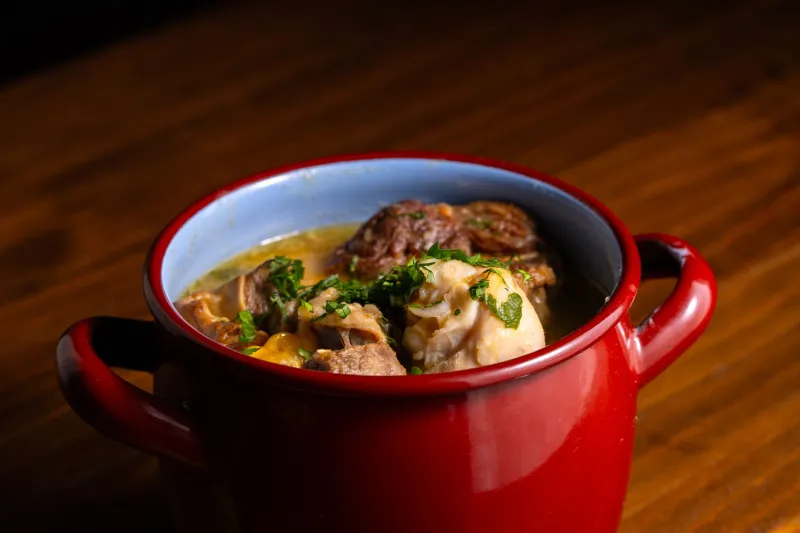
On a wet Tuesday in November, a plate lands at a table near the window of The Bull. It is a slow braise of some sort — beef shin, perhaps, or venison — with roots underneath and a dark gravy that has spent the afternoon reducing. It smells extraordinary. It looks, if we are honest, like a brown daydream. There is no towering garnish, no edible flower and no swirl of sauce applied with a pair of tweezers. If you tried to photograph it from above, the ceiling lights would bounce off the gravy and the whole thing would resemble a weather map.
And yet it is exactly the sort of food a village pub should be cooking in November. That is the quiet problem with the way we talk about pub food now: the plates that photograph best are not always the plates that eat best.
The tyranny of the top-down shot
Social media has changed the way many kitchens think about presentation. That is not automatically a bad thing. A bit of care on the plate is welcome. Nobody wants a shepherd's pie that looks like it was assembled during a minor earthquake. But there is a difference between making food look appetising and making it perform for a camera.
Camera-friendly dishes tend to share certain traits: height, colour contrast, a crisp edge, something green perched on top, a sauce that sits still long enough to be captured. They are often excellent in their own right. But the pressure to make every dish "shareable" can push menus towards the photogenic and away from the slow, brown, generous cooking that suits a cold evening in Wargrave.
A stew is a hard sell on Instagram. A suet pudding is even harder. It arrives as a pale dome, or perhaps slumped slightly, with gravy pooling around it like a small brown moat. It does not gleam. It does not stack. It certainly does not look good in a square crop. What it does do is taste of beef fat, flour, seasoning and time — and that is a far better recommendation than a nice shadow.
What the camera cannot taste
A photograph can tell you that a plate is neat. It cannot tell you whether the meat collapses under a fork or resists it like a stubborn boot. It cannot tell you whether the gravy has body or whether it is merely brown liquid with ambitions. It cannot tell you whether the cabbage has been cooked with butter and patience or simply waved near a pan.
This is where unphotogenic food often earns its keep. Slow braises, game stews, suet puddings, braised greens, root vegetables roasted until their edges caramelise and their middles go soft — these are not dishes that flatter a camera. They are dishes that reward a diner. Their appeal is in texture, depth and warmth. They are food for a wet walk back from the river, for a table of friends, for a pint that has been allowed to settle.
At The Bull, the winter menu leans into that. There are plates that look tidy and plates that look like a geological event. The latter are often the ones worth ordering. A game stew with a dark, glossy sauce and a spoonful of something sharp on the side will never trend. It will, however, disappear from the plate with remarkable speed.
The fork test
A useful way to judge a pub plate is to ignore the first photograph and pay attention to the third forkful. Does the dish hold together? Does it taste better after the initial hit of salt and fat? Does the gravy cling to the meat or slide off it? Is the plate warm? Is there enough sauce to finish the potatoes, or does the whole thing go dry halfway through?
These are not glamorous questions. They are the questions that actually matter when you are hungry on a Tuesday in November. A plate can be beautiful and still be a disappointment. A plate can look like something the dog dragged in and be one of the best things you eat all month.
That is not an argument for carelessness. There is a difference between honest, unpretentious food and a kitchen that has stopped trying. A good pub plate should still look like someone thought about it. The gravy should be in the right place. The garnish should have a reason to be there. But the reason should not be the camera.
A village pub is not a content studio
The Bull is a pub in Wargrave, not a set for a food shoot. People come in with muddy boots, dogs, children, grandparents and a reasonable expectation of lunch. They want food that feels made for them, not styled for an audience. The best winter cooking often has a slightly unruly quality: a suet pudding that slumps when you cut into it, a stew that stains the mash, a gravy that demands bread.
That is the sort of food worth talking about. It is also the sort of food that is best judged by the empty plate rather than the camera roll. So this winter, order the brown thing. Put the phone down. Pick up the fork. The unphotographed plate rarely lets you down.